

See where your kick and bass fight.
PULSE is a plug-in for the kick and bass relationship in electronic music. A live collision map shows where and when the two fight, with a carve suggestion telling you which one to cut, where and by how much. Then sculpt a sub that translates from phone to club, and glue the low end to the kick.
$39 launch price until Sunday, November 15, 2026 $49
One-time purchase · Free trial with no time limit (analysis only) · Works fully offline
Why your low end falls apart
Mud is usually two sounds fighting over the same frequencies at the same moments.
A kick that disappears when the bass comes in, a drop that sounds huge in the studio and vanishes on a phone: PULSE shows you exactly where that happens and gives you the tools to fix it, with three modules sharing one analysis engine.
Put one PULSE on your kick + bass group (Bus role). No routing at all.
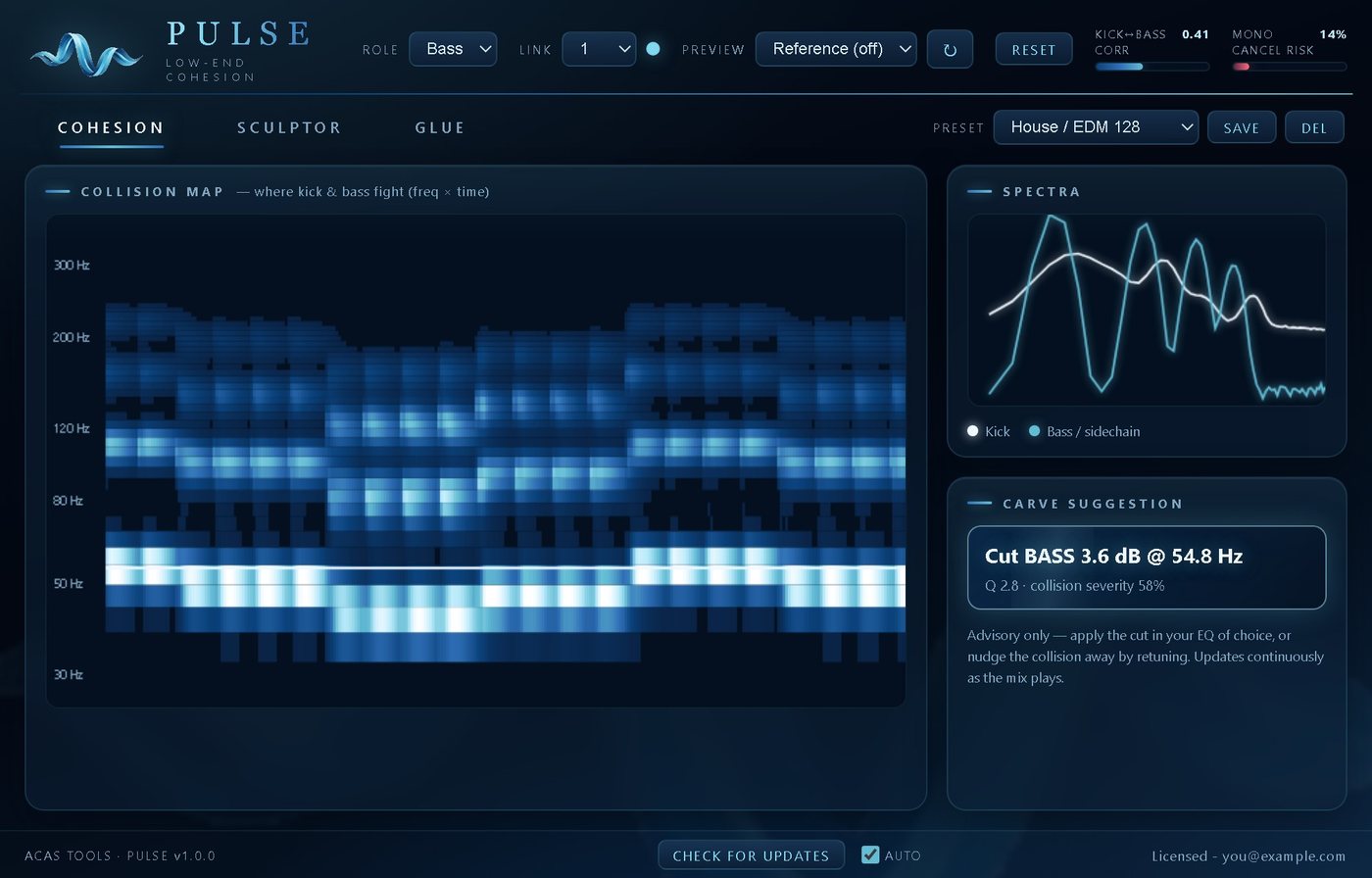
Play your busiest 8 bars and watch the collision map light up where kick and bass both carry energy at once.
Read the carve suggestion: which source to cut, at what frequency, how deep and with what Q. Apply it in your own EQ.
Use the Sub Harmonic Sculptor to keep the sub audible on phones, and check it with the translation preview.
Turn on Transient-Locked Glue so the low end breathes in the kick's rhythm and nothing else.
Cohesion Engine
See the fight, not just the spectrum
The collision map (25 to 400 Hz) isn't a spectrogram: a spot lights up only when kick and bass both carry energy there at the same moment. Brighter means a harder fight.
- Live kick and bass spectra, so you can see whose fundamental owns which region
- Kick-bass correlation and Mono Cancel Risk meters for phase trouble and mono loss
- One continuously updated, advisory EQ move aimed at whichever source loses less
Sub Harmonic Sculptor
Translate from phone to club
Phone presence and club weight become two separate decisions.
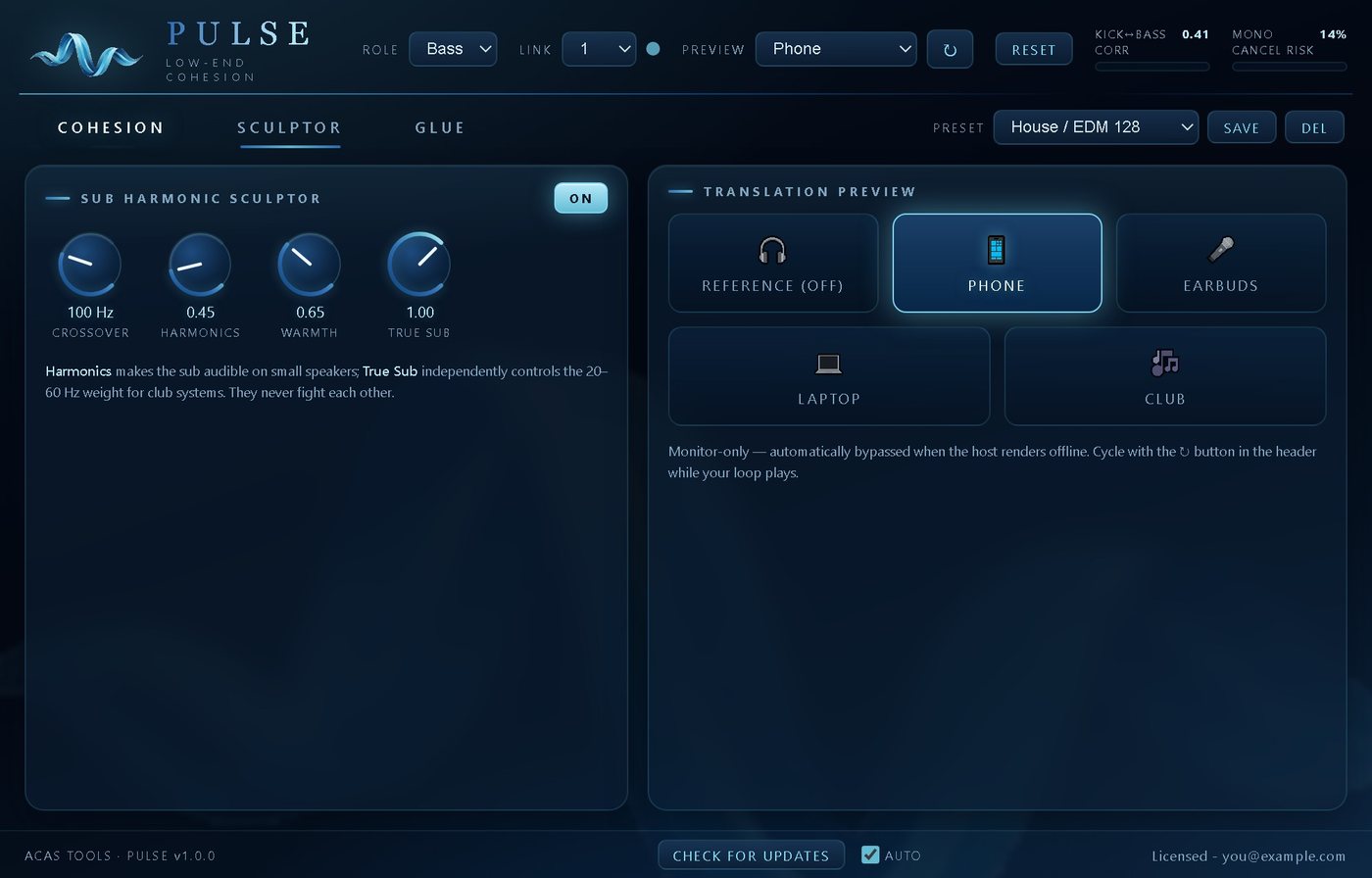
- Harmonics keep the sub audible on small speakers; Warmth balances the rounder 2nd against the harder 3rd
- True Sub: an independent level for the untouched 20 to 60 Hz
- Translation preview: hear your low end as a Phone, Earbuds, Laptop or Club system would. Monitor-only, never printed to a bounce
Transient-Locked Glue
Duck on the kick, not on the bass
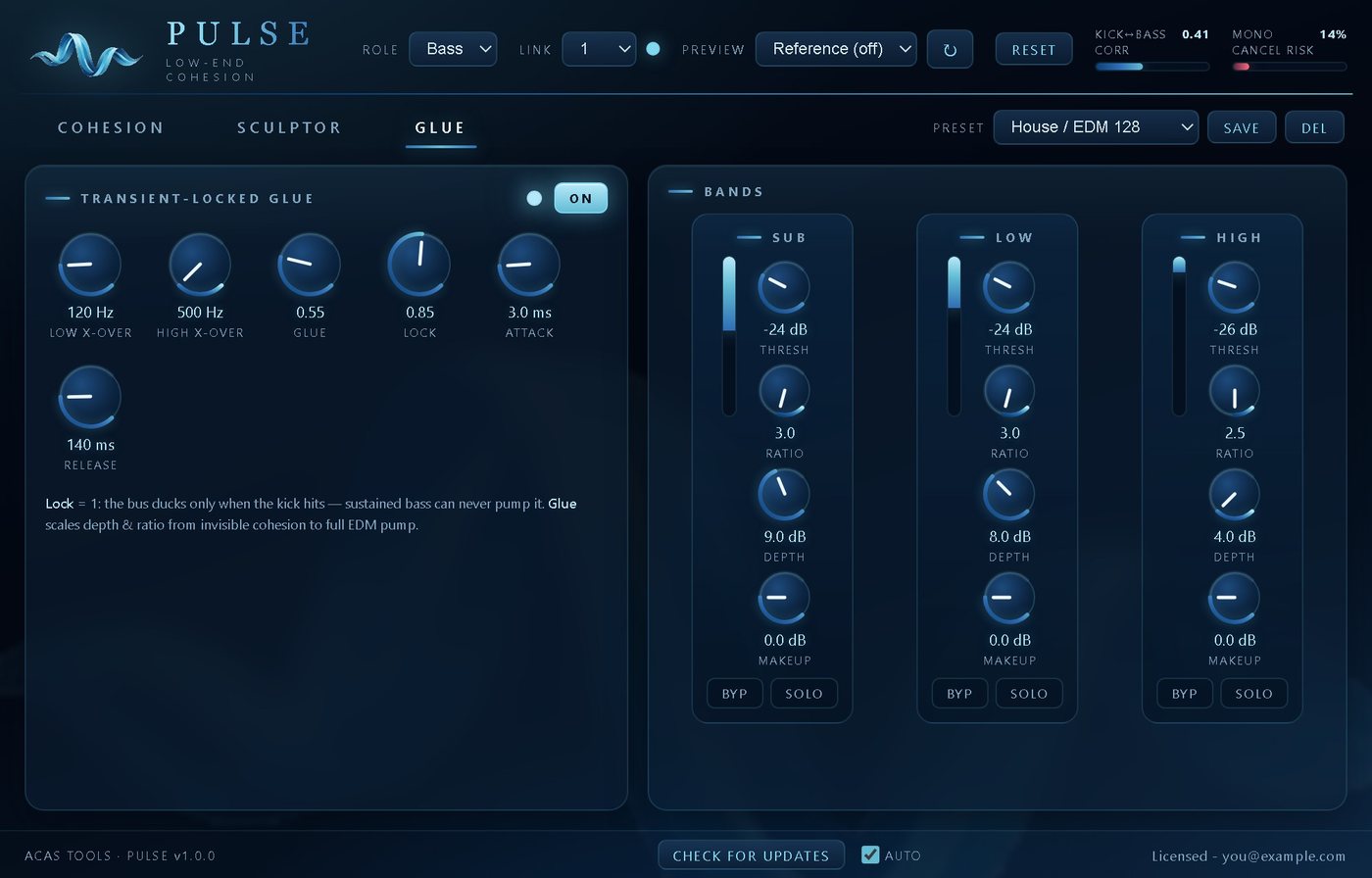
Ordinary glue compressors react to level, so a sustained bass note pumps them just like a kick. PULSE's three-band compressor (SUB, LOW, HIGH) triggers on detected kick hits.
- Glue: one macro from invisible cohesion to full pump
- Lock: blends level-based compression with pure transient-locked ducking
- Attack, release, and per-band threshold, ratio, depth, makeup, bypass and solo
Three roles, no routing required
Drop it on the group and play.
Bus, Bass or Kick
One PULSE on the kick + bass group needs no routing. On the bass with the kick in the sidechain, you get the tightest glue.
Linked mode
Put one PULSE on the kick and one on the bass, pick the same link group, and they share analysis with zero routing when both run in the same DAW process.
Presets that can't break routing
Factory presets for House / EDM 128, Trance 138 and DnB 174, plus your own. Presets never change Role, Link or Preview.
Honest limits
What PULSE is not.
Not an EQ
The carve suggestion is advisory. You apply it in the EQ you already use, or retune the bass.
Not a mastering tool
It isn't a limiter or a full-mix processor. It works on the low end.
The trial doesn't process
All analysis is free with no time limit. Sculptor, Glue and the translation preview are bypassed until you activate, so audio passes through untouched.
Windows
Windows 10 or 11, 64-bit, VST3 host
Mac
Intel or Apple Silicon, macOS 11 or later, VST3 or AU host
Linked mode
Both instances in one DAW process (the default in Live, FL Studio, Logic and Cubase); otherwise use sidechain routing.
Free trial
Find the fight in your busiest 8 bars.
The trial has no time limit: the collision map, spectra, meters, carve suggestion and Linked mode all work in full. A license turns on the processing. One license covers up to 3 computers you own, with updates included.
Questions: [email protected] · License terms · VST is a trademark of Steinberg Media Technologies GmbH.